Copyright and neighbouring rights play a crucial role in protecting creative works and rewarding creators. In Uganda, these rights are governed primarily by the Copyright and Neighbouring Rights Act, 2006. While the law is designed to promote creativity and safeguard intellectual property, it also presents several practical and structural challenges—especially in today’s fast-evolving digital environment.
This article explores the key disadvantages of copyright and neighbouring rights in Uganda, highlighting how they affect creators, users, and the broader creative economy.
1. An Outdated Legal Framework in a Digital Age
One of the most significant challenges is that Uganda’s copyright law was enacted in 2006, long before the explosion of digital platforms, streaming services, and artificial intelligence technologies. As a result, the law does not adequately address modern issues such as online piracy, digital distribution, and data use for machine learning.
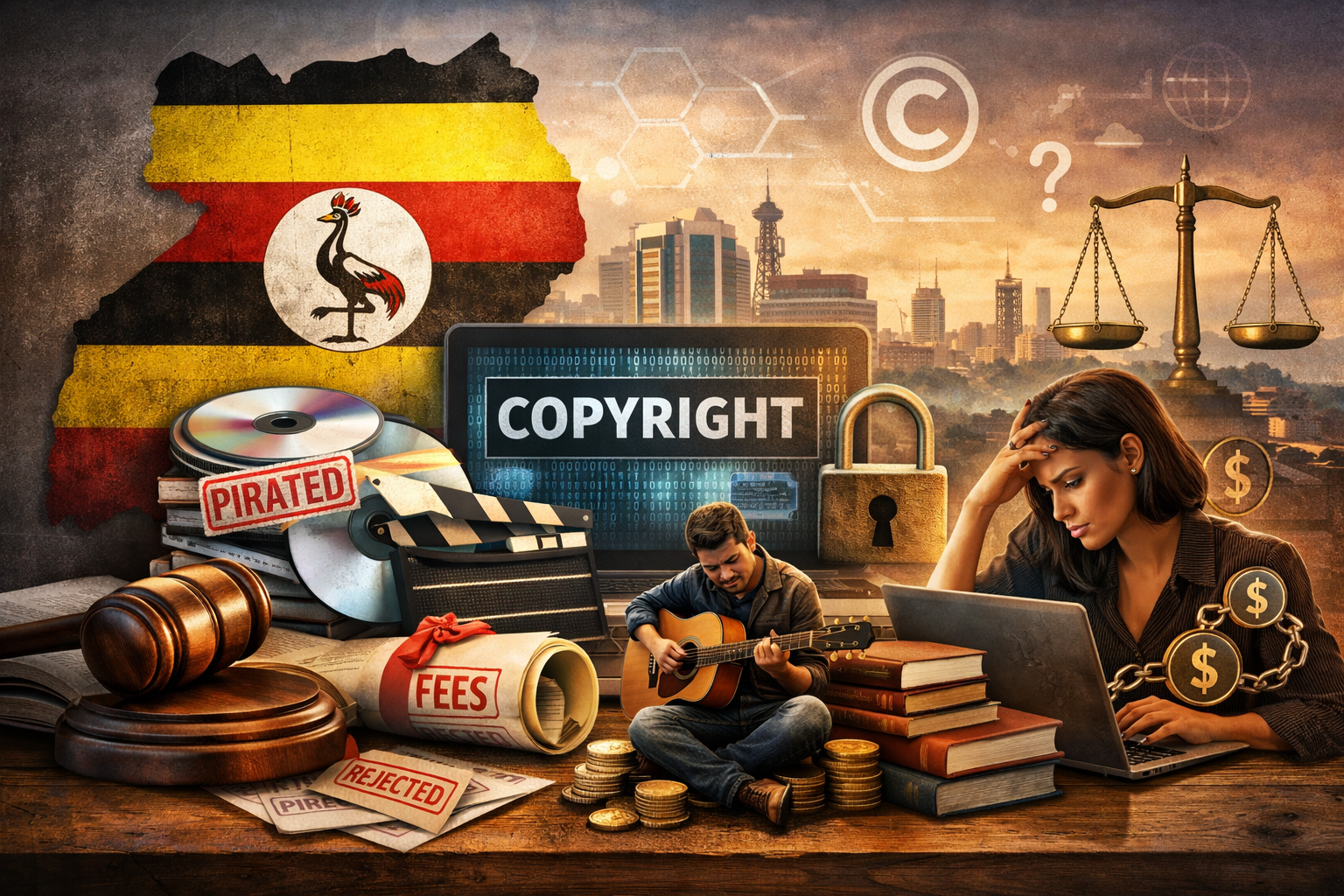
This gap creates uncertainty for both creators and users, making enforcement less effective and limiting the law’s relevance in the digital economy.
2. Weak Enforcement and Widespread Piracy
Although the law provides for penalties against copyright infringement, enforcement remains weak in practice. Pirated music, films, and books are widely available in Uganda, often with little consequence for offenders.
The cost and complexity of monitoring infringement, combined with limited institutional capacity, mean that many rights holders struggle to protect their works effectively. This undermines the very purpose of copyright protection.
3. Limited Public Awareness
A large portion of creators and users in Uganda lack adequate knowledge about copyright and neighbouring rights. Many artists are unaware of how to protect their works, while users may unknowingly infringe on protected content.
This lack of awareness reduces the effectiveness of the legal framework and leads to lost income for creators.
4. Cost and Administrative Barriers
Registering and managing copyright in Uganda involves formal procedures and fees. For small-scale creators, startups, and informal sector participants, these costs can be prohibitive.
As a result, many creators operate outside the formal system, leaving their works unprotected and limiting their ability to enforce their rights.
5. Complexity Arising from Neighbouring Rights
Neighbouring rights extend protection to performers, producers, and broadcasters. While this broadens protection, it also introduces complexity.
A single piece of work may involve multiple rights holders, each requiring separate permissions. This can lead to:
Increased transaction costs
Delays in licensing
Multiple payment obligations for a single use
Such complexity discourages efficient use and distribution of creative works.
6. Inequitable Distribution of Revenue
Despite legal protections, many creators—especially performers—do not receive a fair share of the revenue generated from their works. Intermediaries such as record labels, producers, and collecting societies often control the flow of income.
This imbalance raises concerns about whether the system truly benefits the individuals it is meant to protect.
7. Restrictions on Access and Creativity
Copyright grants exclusive rights to creators, meaning others must seek permission to use protected works. While this protects ownership, it also restricts access to knowledge and cultural materials.
In educational settings, this can limit access to learning resources. In creative industries, it can discourage derivative works such as remixes, adaptations, and parodies.
8. Limited Exceptions and Flexibility
Uganda’s copyright system provides for limited exceptions (often referred to as fair dealing). However, these exceptions are relatively narrow and do not offer the same flexibility seen in some other jurisdictions.
This restrictiveness can hinder innovation, research, and educational use of copyrighted materials.
9. Orphan Works and Ownership Challenges
Some works have unknown or untraceable owners, commonly referred to as orphan works. Under Uganda’s legal framework, using such works without permission is risky.
As a result, valuable cultural and historical materials may remain unused, limiting their contribution to society.
10. Long Duration of Protection
Copyright protection in Uganda lasts for many years, often extending beyond the life of the author. While this benefits rights holders, it delays the entry of works into the public domain.
This slows the free exchange of knowledge and limits opportunities for cultural reuse and innovation.
11. Challenges with Collective Management Organizations
Collective management organizations are responsible for administering rights and distributing royalties. However, concerns have been raised about transparency, accountability, and efficiency.
Disputes over royalty distribution and governance issues can reduce trust in these institutions and discourage creators from relying on them.
12. High Cost of Legal Enforcement
When disputes arise, resolving them through the legal system can be expensive and time-consuming. Many creators, particularly those with limited resources, are unable to pursue legal action.
This creates a situation where rights exist in theory but are difficult to enforce in practice.
Conclusion
While copyright and neighbouring rights are essential for protecting creativity and encouraging innovation, their implementation in Uganda presents notable challenges. From weak enforcement and limited awareness to legal complexity and unequal economic outcomes, the system does not always function as intended.
Addressing these disadvantages will require legal reforms, improved enforcement mechanisms, greater public awareness, and more inclusive systems that support both creators and users in a rapidly evolving digital landscape.
Only then can copyright and neighbouring rights fully achieve their goal of fostering a vibrant and sustainable creative economy in Uganda.